
Eisenhower Matrix for 1:1 Meetings Helping Middle Managers Stay Organized and Focused

A 1:1 meeting can be the most useful 30 minutes of a manager’s week, or it can become a running list of half-finished updates. The difference is often not effort. It is structure.
Middle managers sit between strategy and execution. They translate senior priorities, coach direct reports, remove blockers, and still manage their own deliverables. Recent research on remote and hybrid work shows that collaboration patterns have become more fragmented, with more digital communication and more coordination demands (Yang et al., 2022; DeFilippis et al., 2022). That makes focused 1:1s more valuable, not less.
The Eisenhower Matrix gives managers a practical way to sort the noise. It separates work by urgency and importance, so each conversation stays tied to decisions, support, and follow-through.

The Eisenhower Matrix fits the real pressure of middle management
The Eisenhower Matrix has four quadrants:
Urgent and important
Handle now because delay creates risk.
Urgent but not important
Delegate, redirect, or contain.
Important but not urgent
Plan because it supports growth, quality, or long-term goals.
Not urgent and not important
Remove, pause, or revisit only if conditions change.
For middle managers, this is more than a productivity tool. It is a way to protect the purpose of the 1:1.
Without a sorting method, every item can feel equal. A frustrated customer, a development goal, a late report, and a vague team concern all compete for attention. The matrix helps the manager and employee decide what needs a decision, what needs coaching, what needs ownership, and what should stop taking meeting time.
That matters because manager attention is limited. Gallup’s 2024 workplace reporting continues to connect manager behavior with employee engagement and daily work experience. Industry guidance from Atlassian also treats 1:1s as a recurring space for trust, feedback, and removing obstacles, not just status reporting.
Use the matrix before the 1:1 starts
The best use of the matrix happens before the meeting. A middle manager can ask the employee to add agenda items under four headings in a shared note or simple template.
A short agenda might look like this:
Do first. Customer renewal risk needs a decision by Friday.
Schedule. Discuss career path for the next quarter.
Delegate. Decide who should answer a cross-team data request.
Drop. Remove a recurring update that no longer needs discussion.
This keeps both people from walking into the meeting with competing hidden priorities. It also reduces the chance that the loudest item wins.
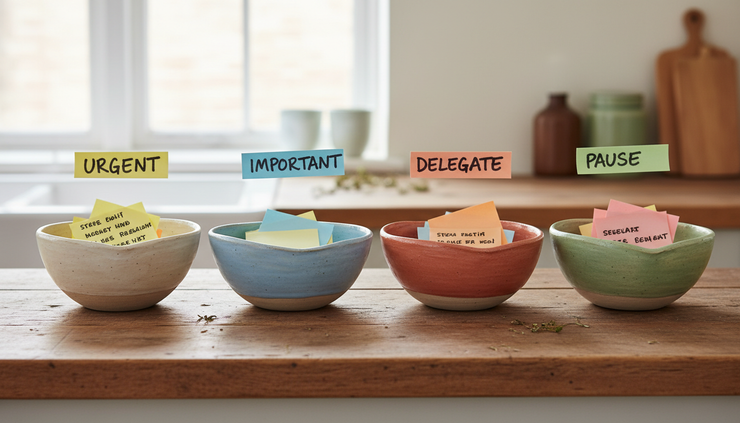
A useful rule is to limit each quadrant. If the employee adds 12 “urgent and important” items, the real task is not to discuss all 12. The task is to find the two or three that carry the most risk.
Run the meeting by quadrant, not by habit
A standard 1:1 often starts with “What’s on your mind?” That question can be helpful, but it can also send the conversation anywhere.
The matrix gives the meeting a clearer flow.
Start with urgent and important work
Use the first few minutes for items that need action now. These might include delivery risks, interpersonal conflict affecting work, customer issues, or decisions blocked by missing information.
Ask direct questions:
What happens if this waits?
What decision is needed today?
Who owns the next step?
What support would change the outcome?
This keeps the meeting on task and helps avoid a common middle-management trap: absorbing every problem instead of clarifying ownership.
Protect time for important but not urgent topics
This quadrant is where many 1:1s create the most value. It includes coaching, skill growth, process improvements, career goals, workload patterns, and team health.
These topics rarely feel urgent until they become problems. Research on work design continues to show that autonomy, clarity, and manageable demands shape how people experience work (Shirmohammadi et al., 2022). A good manager uses the 1:1 to address those factors before burnout, confusion, or disengagement grows.
A practical cadence is to reserve at least 10 minutes for this quadrant every other meeting. If urgent items always consume the full agenda, the 1:1 becomes reactive by design.

Contain urgent but less important work
Some work feels urgent because someone asked loudly or late. That does not mean the manager and employee should spend a full 1:1 solving it.
For this quadrant, decide whether to delegate, redirect, batch, or answer quickly. For example, a request for a basic report might need a template, not a long discussion. A low-risk approval might move to chat. A recurring interruption might need a boundary.
This is where middle managers gain back time. They stay responsive without letting every request set the agenda.
Remove what does not belong
The “not urgent and not important” quadrant is useful because it gives managers permission to stop. Some topics stay on agendas because nobody removed them.
Examples include:
Updates already visible in a project tool
Repeated discussion of decisions already made
Low-value metrics no one uses
Topics better handled in a team channel
Removing these items makes the 1:1 feel lighter and more focused.
Turn the last five minutes into follow-through
A matrix-based 1:1 should end with a short recap. Without that, even a focused conversation can fade into good intentions.
Use the final five minutes to capture:
Meeting output | What to write down |
Decisions | What was decided and why |
Owners | Who will take the next step |
Dates | When the update or action is due |
Carryover items | What belongs in the next 1:1 |
This habit supports accountability without turning the conversation into surveillance. It also helps the manager prepare for the next meeting faster.
Microsoft’s 2023 Work Trend Index described information overload as a major drag on productive work. Clear meeting notes are a small but useful defense against that overload. They reduce rework, repeated explanations, and “Where did we land on that?” messages.
The benefits go beyond a cleaner agenda
Using the Eisenhower Matrix in 1:1s helps middle managers in several practical ways.
It creates focus because every topic has a place.
It improves prioritization because urgency no longer gets confused with importance.
It supports employee development because growth topics are scheduled, not squeezed in if time remains.
It builds trust because direct reports see that their concerns are not lost, ignored, or randomly handled.
It improves manager capacity because delegation and deletion become normal parts of the conversation.
PMI’s recent industry guidance on project success highlights power skills such as communication, leadership, and problem solving. The matrix supports all three. It gives managers a shared language for tradeoffs, which is often what middle management requires most.

A simple template for the next 1:1
Copy this into a shared note before the next meeting:
Do first
What needs a decision or action before the week ends?
Schedule
What matters to goals, growth, quality, or team health?
Delegate
What should move to another owner, channel, or process?
Drop
What no longer deserves 1:1 time?
Then close with three lines:
Decision made
Owner
Due date
The Eisenhower Matrix for 1:1 meetings works because it respects a manager’s real constraints. It does not add ceremony. It adds judgment. For middle managers carrying pressure from every direction, that judgment is what keeps the meeting organized, useful, and focused on work that deserves attention.
How I apply this approach
I personally use this approach in preparing for my 1:1 meetings. If my work week starts on Monday, then I create a matrix from last week's matrix and assess this weeks priorities and risks. This generates my new matrix and closes the loop on the last matrix. When I meet with my supervisor, I am focused on urgent/important and non-urgent/important during my meeting. This allows my supervisor an opportunity to coach and mentor me in the non-urgent/important items before they become urgent.
References
Atlassian. (2024). The Atlassian team playbook: 1-on-1 meetings. https://www.atlassian.com/team-playbook/plays/one-on-one
DeFilippis, E., Impink, S. M., Singell, M., Polzer, J. T., & Sadun, R. (2022). The impact of COVID-19 on digital communication patterns. Nature Human Behaviour, 6(1), 122–130.
Gallup. (2024). State of the global workplace: 2024 report. https://www.gallup.com/workplace/349484/state-of-the-global-workplace.aspx
Microsoft. (2023). 2023 Work Trend Index annual report: Will AI fix work? https://www.microsoft.com/en-us/worklab/work-trend-index/will-ai-fix-work
Project Management Institute. (2023). Pulse of the profession 2023: Power skills, redefining project success. https://www.pmi.org/learning/thought-leadership/pulse/power-skills-redefining-project-success
Shirmohammadi, M., Au, W. C., & Beigi, M. (2022). Remote work and work-life balance: Lessons learned from the COVID-19 pandemic and suggestions for HRD practitioners. Human Resource Development International, 25(2), 163–181. https://doi.org/10.1080/13678868.2022.2047384
Yang, L., Holtz, D., Jaffe, S., Suri, S., Sinha, S., Weston, J., Joyce, C., Shah, N., Sherman, K., Hecht, B., & Teevan, J. (2022). The effects of remote work on collaboration among information workers. Nature Human Behaviour, 6(1), 43–54. https://doi.org/10.1038/s41562-021-01196-4


Comments