
From Silos to Synergy: Leading Stage 2 Teams Toward Shared Purpose

A Stage 2 organizational environment does not usually announce itself with open rebellion. It shows up in quieter ways (according to Logan, King, and Fischer-Wright, 2011): “nothing ever changes,” “leadership doesn’t listen,” “that’s not my job,” or “why bother?” If the prior discussion focused on reframing negative workplace language, this post builds on that idea by looking at the culture beneath the words.
In the Tribal Leadership model (Logan, King, & Fischer-Wright, 2011), Stage 2 is marked by a shared story of resignation. The unspoken belief is, “my life is bad here.” People may comply, but they do not commit. For middle managers, the work is not to force positivity. The work is to help people experience evidence that effort, voice, and connection still matter.

Stage 2 language is a symptom, not the root problem
Negative workplace language is easy to correct and hard to understand. A manager might hear complaints and respond with, “Let’s stay positive.” That may quiet the room, but it rarely changes the culture.
Stage 2 language often points to low trust, weak belonging, and little confidence that action will lead to change. Recent workplace research supports this concern. Gallup’s global workplace reporting continues to connect employee engagement with manager behavior, wellbeing, and whether people feel connected to meaningful work (Gallup, 2024). The American Psychological Association also reports that psychological wellbeing and workplace culture remain central concerns for U.S. employees (American Psychological Association, 2024).
The key question is not, “How do I stop people from complaining?” A better question is, “What would people need to see before a different story became believable?”
Look for the patterns that keep silos alive
Stage 2 teams often organize around self-protection. People share information slowly, blame other groups quickly, and avoid risk unless someone else goes first.
Common signs include:
Learned helplessness
People assume decisions are already made or that feedback will disappear into a void.
Transactional cooperation
Teams help each other only when required, not because shared success matters.
Identity built around frustration
People bond through complaint more than contribution.
Manager dependence
The manager becomes the translator, referee, and rescuer for every cross-team issue.
This matters because modern work depends on coordination. Microsoft’s Work Trend Index has highlighted how fragmented communication and meeting overload can leave employees busy but unclear about priorities (Microsoft, 2023). In a Stage 2 climate, that confusion can turn into proof that “nothing works around here.”

Move from correction to evidence
Reframing negative language still matters, but Stage 2 teams need more than better phrasing. They need repeated proof that a new way of working is safe and useful.
Replace vague optimism with specific agency
Instead of saying, “Let’s have a better attitude,” name the controllable next step.
Try:
“We may not control the timeline, but we do control what information we give the implementation team by Friday.”
This shifts the group from helplessness to action without denying the frustration.
Build one visible win at a time
Large culture efforts often fail because they feel abstract. Stage 2 teams respond better to small wins that people can see.
Choose one friction point:
Delayed handoffs
Repeated rework
Confusing approvals
Unclear ownership
Slow responses between teams
Then create a short experiment. Define the problem, name the owner, set a short review date, and share what changed. McKinsey’s recent work on organizational health points to the growing need for adaptable, connected organizations rather than rigid silos (McKinsey & Company, 2023).
Use psychological safety with accountability
Psychological safety is not comfort without standards. It means people can speak honestly, ask for help, and admit mistakes without being punished for candor. Research continues to frame psychological safety as a key condition for learning behavior in groups (Edmondson & Bransby, 2023).
For a Stage 2 team, that may sound like:
“I want the real concern on the table. Then we will decide what action we own.”
That sentence protects honesty and moves the team toward responsibility.
Change the tribe through triads, not speeches
In Tribal Leadership, culture shifts when relationships shift (Logan, King, & Fischer-Wright, 2011). A manager cannot carry every connection. Stage 2 teams move forward when people start building trust across boundaries.
One practical move is the triad: connect two people or groups around a shared purpose, then stay present long enough to help the relationship form.
For example:
“Jordan, you need cleaner intake notes. Priya, your team needs fewer late changes. Let’s map the handoff together and agree on one improvement for next week.”
This is different from telling people to collaborate. It gives them a shared problem, a short time frame, and a reason to see each other as partners.
What progress sounds like
A Stage 2 team does not jump straight into high trust. Listen for small language shifts:
Stage 2 signal | Healthier replacement |
“They never tell us anything.” | “Who do we need information from?” |
“That team always drops the ball.” | “Where is the handoff breaking?” |
“Nothing will change.” | “What can we test for two weeks?” |
“That’s above my pay grade.” | “What part can we influence?” |
The goal is not forced cheerfulness. The goal is shared ownership that feels credible.
The manager’s takeaway
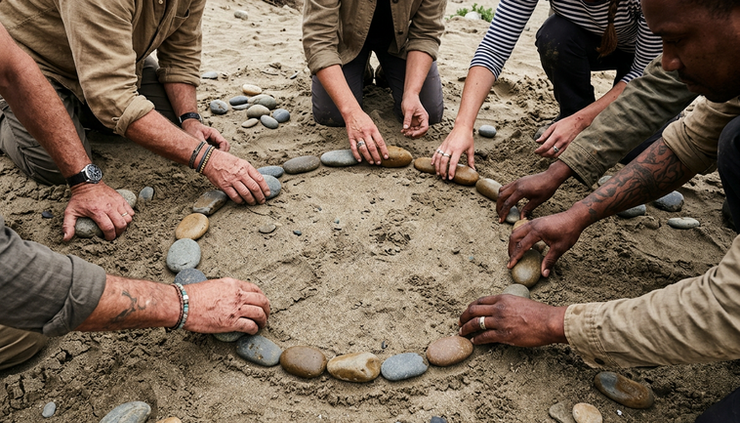
Stage 2 teams are not broken. They are often disappointed, tired, and unconvinced that participation will pay off. Middle managers can help by treating negative language as cultural data, not disrespect.
Start small. Name the pattern. Create one visible win. Connect people across silos around a real problem. Then repeat.
Shared purpose becomes believable when people can point to moments where working together made the day better.
References
American Psychological Association. (2024). 2024 Work in America survey. https://www.apa.org/pubs/reports/work-in-america/2024
Edmondson, A. C., & Bransby, D. P. (2023). Psychological safety comes of age: Observed themes in an established literature. Annual Review of Organizational Psychology and Organizational Behavior, 10, 55–78. https://doi.org/10.1146/annurev-orgpsych-120920-055217
Gallup. (2024). State of the global workplace: 2024 report. https://www.gallup.com/workplace/349484/state-of-the-global-workplace.aspx
Logan, D., King, J., & Fischer-Wright, H. (2011). Tribal leadership: Leveraging natural groups to build a thriving organization. Harper Business: New York, NY.
McKinsey & Company. (2023). The state of organizations 2023: Ten shifts transforming organizations. https://www.mckinsey.com/capabilities/people-and-organizational-performance/our-insights/the-state-of-organizations-2023
Microsoft. (2023). 2023 Work Trend Index annual report: Will AI fix work? https://www.microsoft.com/en-us/worklab/work-trend-index/will-ai-fix-work


Comments